
Citing Credible Sources to Enhance Content Trust: An SEO Guide
In my years as an SEO consultant, I have seen brilliant content fail simply because it lacked authority. You can write the most engaging prose in the world, but if your claims are baseless, Google—and your readers—will walk away. The practice of citing credible sources to enhance content trust is not just an academic exercise; it is a fundamental pillar of modern SEO strategy.
When we talk about ranking in 2026, we are really talking about E-E-A-T (Experience, Expertise, Authoritativeness, and Trustworthiness). Trust is the hardest metric to fake. It requires evidence. In this guide, I will walk you through exactly how to select, verify, and cite sources to turn your content into a high-authority asset.
The Mechanism: How Citations Impact SEO
Many business owners ask me, “Jaydeep, does linking out hurt my ranking?” The answer is a resounding no—if done correctly. Linking to authoritative sources acts as a vote of confidence. It tells Google’s algorithms that your content is well-researched and connected to the broader knowledge graph of your industry.
E-E-A-T and The Trust Signal
Google’s Search Quality Rater Guidelines are explicit about this. They define expertise not just by what you say, but by how you back it up. When you cite a study or a government regulation, you are effectively borrowing a small piece of that entity’s authority.
Consider the difference between these two statements:
- “SEO is changing rapidly.”
- “According to Google’s helpful content documentation, the focus has shifted entirely to people-first content.”
The second statement carries weight. It signals to the search engine that I am not just guessing; I am interpreting official standards. This alignment with high-authority nodes creates a “trust halo” around your domain.
The Impact on Dwell Time and User Signals
Trust leads to engagement. Users are savvy. If they see a statistic without a source, they hesitate. If they see a hyperlinked citation, they subconsciously verify the claim and keep reading.
Data suggests a strong correlation between sourced content and dwell time. When users feel safe, they stay longer. This reduction in bounce rate is a secondary, yet powerful, SEO signal.
Hierarchy of Evidence: Primary vs. Secondary Sources
Not all links are created equal. In my SEO consulting services, I teach clients to distinguish between primary evidence and secondary opinion. To maximize credibility, you must prioritize the former.
Here is a breakdown of how Google likely weighs different source types:
| Source Tier | Examples | Credibility Score | Best Use Case |
|---|---|---|---|
| Tier 1: Primary | Government (.gov), Academic (.edu), Official Laws, Original Research | High | Definitive proof of facts, laws, or data points. |
| Tier 2: Secondary | Major News Outlets (NYT, BBC), Industry Leaders (Semrush, Moz) | Medium-High | Context, expert commentary, and trends. |
| Tier 3: Tertiary | General Blogs, Wikipedia, Aggregators | Low-Medium | Background info (verify before citing). |
| Tier 4: Avoid | Social Media Rants, Forums (unless for sentiment analysis), Unverified Blogs | Low | Do not use for factual claims. |
The CRAAP Test for Verification
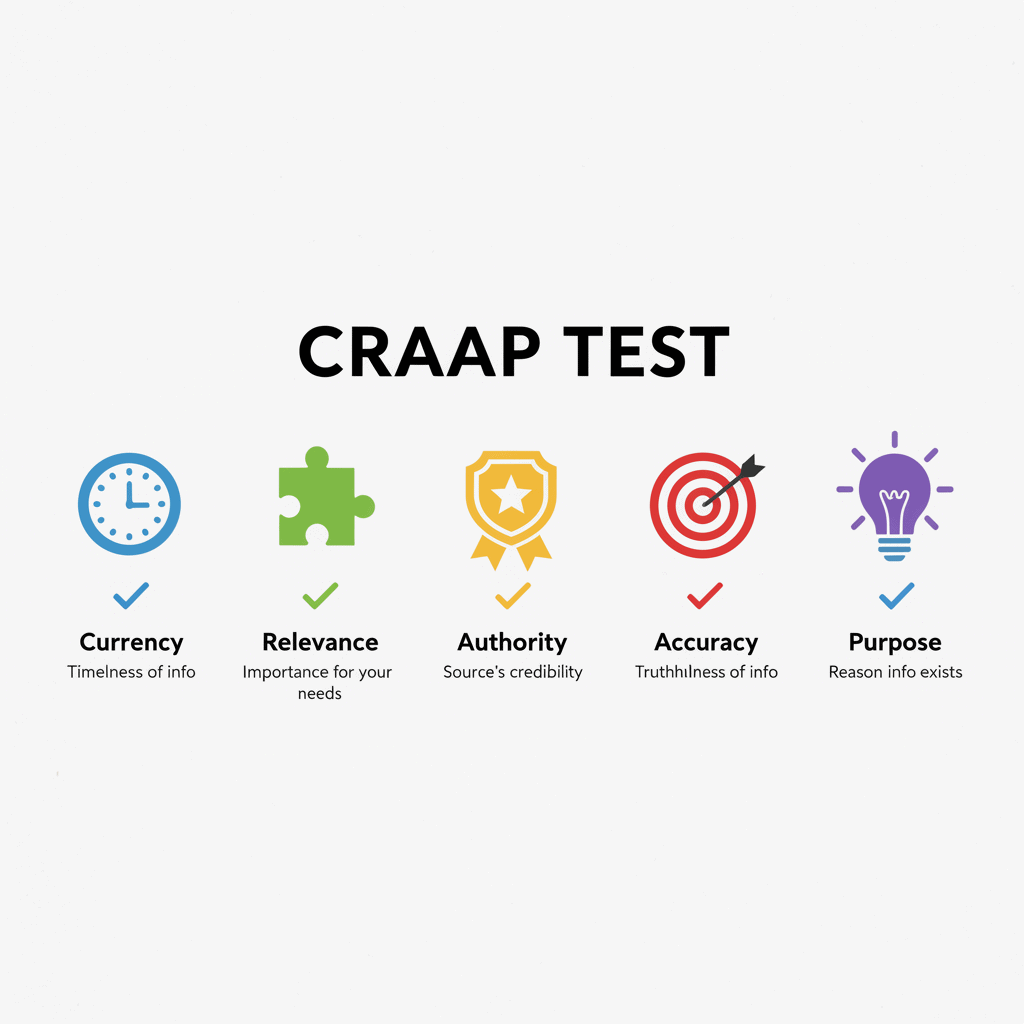
Before I let a link go live on a client’s site, it must pass the CRAAP test. Originally developed by librarians, this method is the gold standard for vetting digital information. I strongly recommend applying the CRAAP test methodology to every external link you consider.
The 5 Pillars of CRAAP:
- Currency: Is the information up to date? A 2015 study on SEO is useless today.
- Relevance: Does this source directly support your argument?
- Authority: Who is the author? Do they have credentials?
- Accuracy: Is the information supported by evidence?
- Purpose: Is the source objective, or are they selling something?
Strategic Sourcing for YMYL Topics
If you are in a “Your Money or Your Life” (YMYL) industry—finance, health, legal—the stakes are higher. Google’s algorithms hold these pages to the strictest safety standards. A wrong citation here does not just hurt rankings; it can actively harm users.
Medical and Financial Compliance
For health content, linking to a wellness blog is insufficient. You must cite medical journals (like PubMed) or major health organizations (CDC, WHO).
A 2022 study on information verification found that users actively check author history and publication frequency to verify news. This behavior mirrors Google’s own quality checks. If you are making a medical claim, ensure the citation leads to a peer-reviewed study, not a news article summarizing that study.
Transparency and the FTC
While Google focuses on ranking, we must also respect legal frameworks like the FTC Endorsement Guides. If you cite a source you have a financial relationship with, you must disclose it. Transparency is the ultimate trust signal.
Best Practices for Citing Sources
Now that we know what to cite, let’s discuss how to cite it without disrupting the user experience. This is where art meets science.
1. Citation Density
How many links are too many? Based on my analysis of top-ranking content:
- Ideal Density: 1 to 3 credible citations per 500 words.
- The Risk: Over-citing can make your content look like a link farm, which triggers spam filters.
- The Balance: Use citations to back up hard claims (stats, dates, laws), not general knowledge.
2. Contextual Attribution
Don’t just drop a link on the word “click here.” Use the entity’s name to build semantic relevance.
- Bad: “Studies show that backlinks matter (Source).”
- Good: “Semrush’s analysis on trust signals highlights that authoritative backlinks are a primary ranking factor.”
This technique, known as Entity Salience, helps Google understand the relationship between your content and the authority you are citing.
3. Deep Linking
Avoid linking to a homepage (e.g., nasa.gov). Always link to the specific page or PDF containing the data (e.g., nasa.gov/reports/2026-climate-data). Deep links prove you actually read the research.
Common Pitfalls to Avoid
Even experienced writers make mistakes. Here are the most common errors I correct in my AI-driven SEO strategies:
- Broken Links (Link Rot): Linking to a 404 page tells Google your content is neglected. Audit your links quarterly.
- Linking to Competitors: Be careful not to link to a direct competitor ranking for your target keyword. Cite neutral authorities instead.
- Ignoring Bias: Check the “About Us” page of your source. If they are funded by a biased entity, their data may be skewed.
Tools for Evaluating Authority
You don’t have to guess. Several tools can help you quantify the trustworthiness of a potential source.
| Tool | Primary Metric | Best For |
|---|---|---|
| Semrush | Authority Score (AS) | Checking the backlink profile of a source. |
| Moz | Domain Authority (DA) | Quick browser extension checks. |
| Media Bias / Fact Check | Bias Rating | Verifying news outlets and political sources. |
| Google Scholar | Citation Count | verifying academic papers. |
The Bottom Line
Citing credible sources to enhance content trust is about more than satisfying an algorithm. It is about respecting your audience. When you take the time to verify your facts and point users to legitimate data, you position your brand as a leader rather than a follower.
For businesses targeting local SEO expertise, this is your competitive advantage. While your competitors churn out generic AI content, you can build a fortress of credibility that stands the test of time.
Key Takeaways
- Prioritize Primary Sources: Always trace data back to the original study or government report.
- Use the CRAAP Test: Verify Currency, Relevance, Authority, Accuracy, and Purpose.
- Optimize Anchor Text: Use descriptive anchors that name the source entity.
- Respect YMYL: Health and finance topics require strict adherence to scientific and legal consensus.
- Audit Regularly: Fix broken links to maintain a high-quality user experience.
FAQ Section
1. Does Google penalize sites for linking out?
No. Linking to high-quality sites is a positive signal. It shows your content is well-researched. However, linking to spammy or irrelevant sites can hurt your reputation.
2. How many citations should I include in a blog post?
A good rule of thumb is 1-3 citations per 500 words. Focus on quality over quantity. Only cite when you are presenting a fact, statistic, or direct quote that needs verification.
3. Can I cite a competitor?
It is generally best to avoid linking to direct competitors for the same keyword. Instead, find the original source they used (like a government study) and link to that directly.
4. What if a source contradicts my argument?
Address it. Acknowledging conflicting evidence and explaining why your perspective holds weight (using better data or more recent context) actually builds higher trust than ignoring it.
5. Do citations need to be hyperlinks?
Yes. While Google can recognize unlinked brand mentions, a hyperlink is a clear, direct signal that allows users and crawlers to verify the source instantly.