

Auditing Existing Blog Posts for Update Opportunities: A 2026 Guide
In the current digital ecosystem, simply churning out new articles is a losing battle. The real growth lever—one that most businesses ignore—lies in auditing existing blog posts for update opportunities. If you have been publishing for more than a year, you are likely sitting on a goldmine of dormant traffic.
My approach to SEO is built on the philosophy that every URL must justify its existence. We don’t just want more pages; we want better performance. In this guide, I will walk you through the exact methodologies I use to turn stagnant archives into high-performing assets, ensuring your content aligns with modern search intent and 2026 ranking factors.
Key Takeaways
• Efficiency Over Volume: Updating old content often yields a higher ROI than creating new posts, with potential traffic lifts of 57% or more.
• Data-Driven Decisions: Use metrics like organic traffic, bounce rate, and backlinks to categorize posts into Keep, Kill, or Combine buckets.
• Technical Health: Core Web Vitals and E-E-A-T compliance are non-negotiable parts of the audit process.
• Regular Cadence: Audits should not be a one-time event; quarterly reviews prevent content decay.
Why Most Content Strategies Fail Without Audits
It is a harsh reality: Semrush data reveals that 95% of web pages get no organic traffic. This statistic should be a wake-up call. If you are not regularly reviewing your library, you are likely accumulating “zombie pages”—content that provides no value to users and dilutes your site’s topical authority.
When we look at the future of SEO for professional firms, it is clear that static content dies quickly. Search engines in 2026 prioritize freshness and utility. An audit isn’t just about cleaning up; it is about signaling to Google that your site is alive, relevant, and maintained by experts.
The ROI of Refreshing Content
Why spend resources on an audit? Because the data supports it. A study analyzing over a million URLs found that updating blog posts older than two years can increase organic traffic by an average of 57%. This is “low-hanging fruit” in its purest form. instead of fighting for authority on a brand new URL, you leverage the existing age and link equity of an old one.
The Inventory Phase: Gathering Your Data
Before we make decisions, we need a complete picture of what we own. You cannot audit what you cannot see. I recommend a three-step data collection process to ensure no URL is left behind.
Step 1: Crawl Your Site
Use a tool like Screaming Frog to crawl your website. This gives you a list of every URL as Google sees it, along with technical data like status codes, word counts, and title tags.
Step 2: Merge with Performance Data
A list of URLs is useless without context. You need to map performance metrics to each URL. I typically export data from Google Analytics (GA4) and Google Search Console (GSC) for the last 12 months.
Key Metrics to Track:
• Organic Traffic: How many visitors did this page get?
• Impressions: Is Google showing this page, even if no one clicks?
• Backlinks: Does this page have authority signals?
• Conversions: Does this page drive business value?
Step 3: Categorize by Intent
Whether you are focused on local SEO vs national SEO, the audit principles regarding user intent remain the same. Tag each post by its primary topic or category. This helps you spot cannibalization—where multiple posts fight for the same keywords.
The Decision Framework: Keep, Kill, Combine
Once your spreadsheet is populated, the analysis begins. I use the “Keep, Kill, Combine” framework. This is the core of auditing existing blog posts for update opportunities. We use DigitalMarketer’s audit framework as a baseline for this categorization, adapting it to specific client needs.
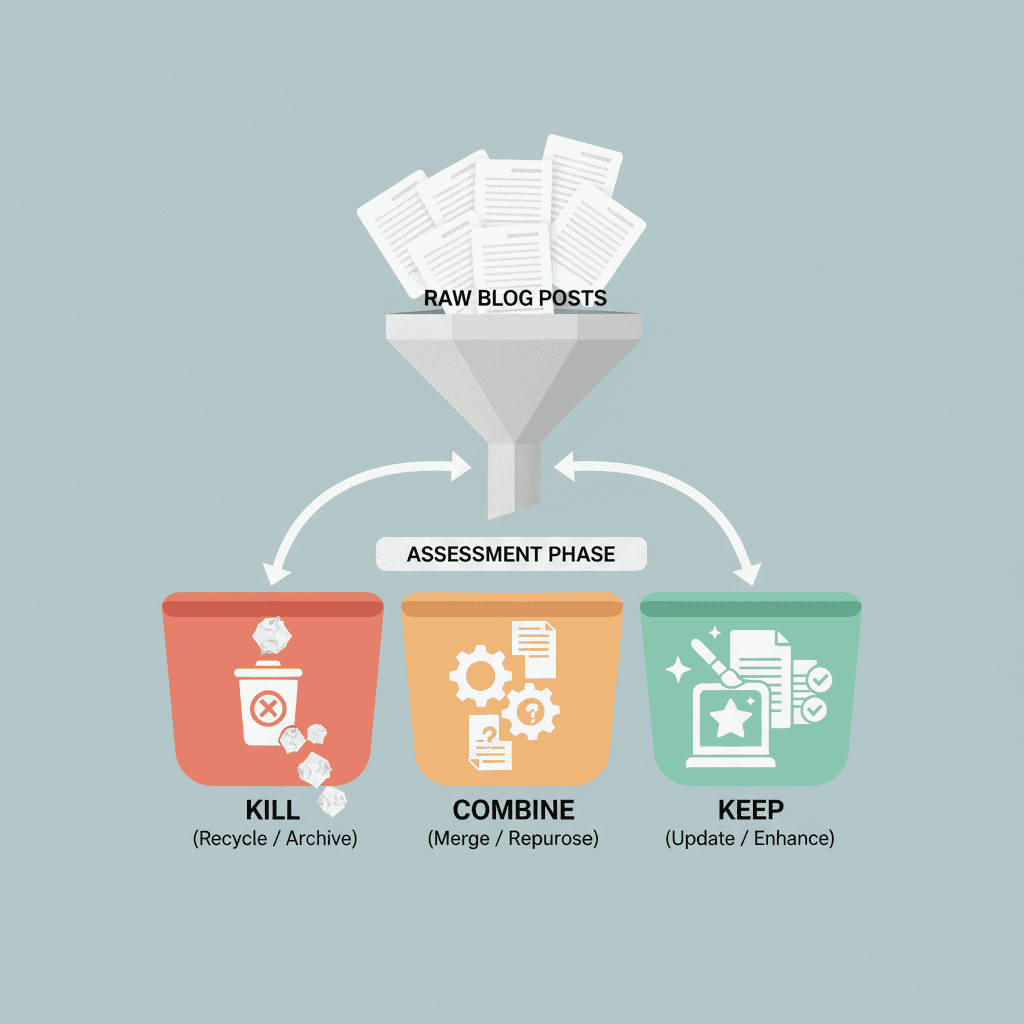
Here is how I determine the fate of a blog post:
| Action | Criteria | Strategic Goal |
|---|---|---|
| Keep (Leave As-Is) | High traffic, high conversions, current information. | Maintain current rankings; monitor for future decay. |
| Update (Refresh) | Good impressions but low clicks; outdated stats; low rankings (page 2-3). | Improve CTR, boost rankings, and restore freshness. |
| Rewrite (Overhaul) | Good topic but poor execution; thin content; wrong search intent. | Re-target the keyword with a completely new angle and better depth. |
| Combine (Merge) | Multiple short posts on similar topics (cannibalization); low traffic individually. | Consolidate authority into one “Power Page” and 301 redirect the others. |
| Kill (Delete) | Zero traffic, zero links, irrelevant topic, duplicate content. | Remove bloat to improve crawl budget and overall site quality. |
Handling Cannibalization
If you find three different posts about “SEO Tips,” you are competing with yourself. Merge them. Take the best sections from each, create one comprehensive guide on the strongest URL, and 301 redirect the other two. This consolidates link equity and often results in an immediate ranking boost.
E-E-A-T and Technical Optimization
Content quality is subjective, but Google’s standards are not. To truly establish E-E-A-T (Experience, Expertise, Authoritativeness, Trustworthiness), you need to build your personal brand with AI and authority mechanisms into every refresh.
The E-E-A-T Checklist for Updates
- Author Bios: Ensure every post has a clear author with credentials.
- First-Hand Experience: Add phrases like “In our analysis…” or “We found that…” to demonstrate you aren’t just summarizing other people’s work.
- Citation Quality: Replace broken links and cite primary sources (like government data or original studies) rather than generic blogs.
Technical Health Check
For technical factors, I often refer to technical SEO audit standards to ensure crawlability. Even the best content won’t rank if the page is broken.
Core Web Vitals Targets:
• LCP (Largest Contentful Paint): Under 2.5 seconds.
• INP (Interaction to Next Paint): Under 200 milliseconds.
• CLS (Cumulative Layout Shift): Less than 0.1.
If a page fails these tests, no amount of keyword stuffing will save it. Fix the technical foundation first.
Prioritizing Your Updates for Maximum Impact
You cannot update 500 posts in a week. Prioritization is key to seeing early results. As noted in Semrush’s guide on SEO audits, prioritizing high-impression pages is critical because they are knocking on the door of success.
The “Quick Wins” Priority Matrix
- High Impressions, Low Clicks: These pages rank but fail to entice clicks. Action: Rewrite titles and meta descriptions.
- Striking Distance (Positions 4-10): These pages are on Page 1 but not top 3. Action: Add depth, FAQs, and schema markup.
- High Traffic, Low Conversion: These pages bring people in but don’t sell. Action: Optimize CTAs and internal linking.
- Decaying Winners: Pages that used to drive traffic but have dropped >20% YoY. Action: Full content refresh and date update.
Measuring Success and ROI
An audit is only successful if it moves the needle. I recommend setting a baseline before you implement changes and reviewing progress at 30, 60, and 90-day intervals.
Success Metrics to Watch:
• Traffic Lift: Percentage increase in organic sessions post-update.
• Keyword Expansion: Are you ranking for more keywords than before?
• Engagement Time: Did the rewrite increase time on page?
• SERP Position: Did you move from position 8 to position 3?
By systematically auditing existing blog posts for update opportunities, you transform your blog from a cost center into a compounding asset. It requires discipline, but the traffic gains are worth the effort.
FAQ Section
What is a content audit and why is it important?
A content audit is a systematic review of all content on your website to assess its strengths and weaknesses. It is crucial because it helps identify underperforming pages, improves SEO rankings, and ensures your content aligns with current business goals and user intent.
How often should I audit my blog content?
For most businesses, a full content audit should be conducted once a year. However, I recommend a “mini-audit” or quarterly review of your top 20 performing pages to ensure they remain fresh and competitive.
What tools do I need for a blog post audit?
The essential stack includes Google Analytics (for traffic data), Google Search Console (for rankings and impressions), and a crawler like Screaming Frog (for inventory). Paid tools like Ahrefs or Semrush are excellent for backlink and keyword data but are not strictly mandatory for a basic audit.
Should I delete old blog posts?
Yes, if they have no traffic, no backlinks, and no potential for improvement. Deleting “zombie pages” allows Google to focus its crawl budget on your high-quality content. Always 301 redirect deleted URLs to a relevant category or homepage if they had any historical value.
How do I identify update opportunities?
Look for pages with high impressions but low clicks, pages that have dropped in rankings over the last 6 months, or content with outdated statistics (e.g., “2023 Trends”). These are your prime candidates for updates.
What is the difference between updating and rewriting?
Updating involves minor tweaks—adding a paragraph, refreshing stats, or fixing links. Rewriting is a major overhaul where you might change the structure, angle, and bulk of the content to better satisfy search intent.
Sources
• Semrush: The Ultimate SEO Audit Guide
• DigitalMarketer: How to Audit Your Existing Blog Content
• Larry Ludwig: Technical SEO Audit Standards