
Improving Website Security Signals For Trust
Table of Contents
- Introduction
- The Mechanics of Trust: Why Google Prioritizes Security
- Core Technical Signals That Build Authority
- E-E-A-T and Security: The Invisible Connection
- Actionable Steps for Hardening Your SEO Defense
- Measuring the Impact on Search Visibility
- Frequently Asked Questions
- Conclusion
Introduction
In my years consulting for businesses in Mumbai and beyond, I have seen a recurring pattern: owners obsess over keywords but neglect the very foundation that holds their rankings together. You might have the best content in the world, but if your digital front door looks like it has a broken lock, Google will hesitate to send visitors your way. This is where improving website security signals for trust becomes not just an IT task, but a critical SEO strategy.
Security is no longer a backend utility; it is a frontend marketing asset. When a user sees a “Not Secure” warning, they do not just leave—they bounce back to the search results, signaling to Google that your site is irrelevant or unsafe. In this guide, I will walk you through the specific security signals that influence the algorithm and how to optimize them to protect your rankings and your reputation.
The Mechanics of Trust: Why Google Prioritizes Security
To understand why security impacts SEO, we have to look at Google’s motivations. Their product is the search result. If they send a user to a compromised site, they lose trust. This is why they have aggressively integrated security checks into their ranking systems.
HTTPS as a Confirmed Ranking Signal
Let’s be clear about the history here. Google officially confirmed HTTPS as a ranking signal back in 2014. It was a “tiebreaker” then, but today, it is the baseline entry fee for ranking. If you are still running on HTTP, you are essentially invisible to modern browsers.
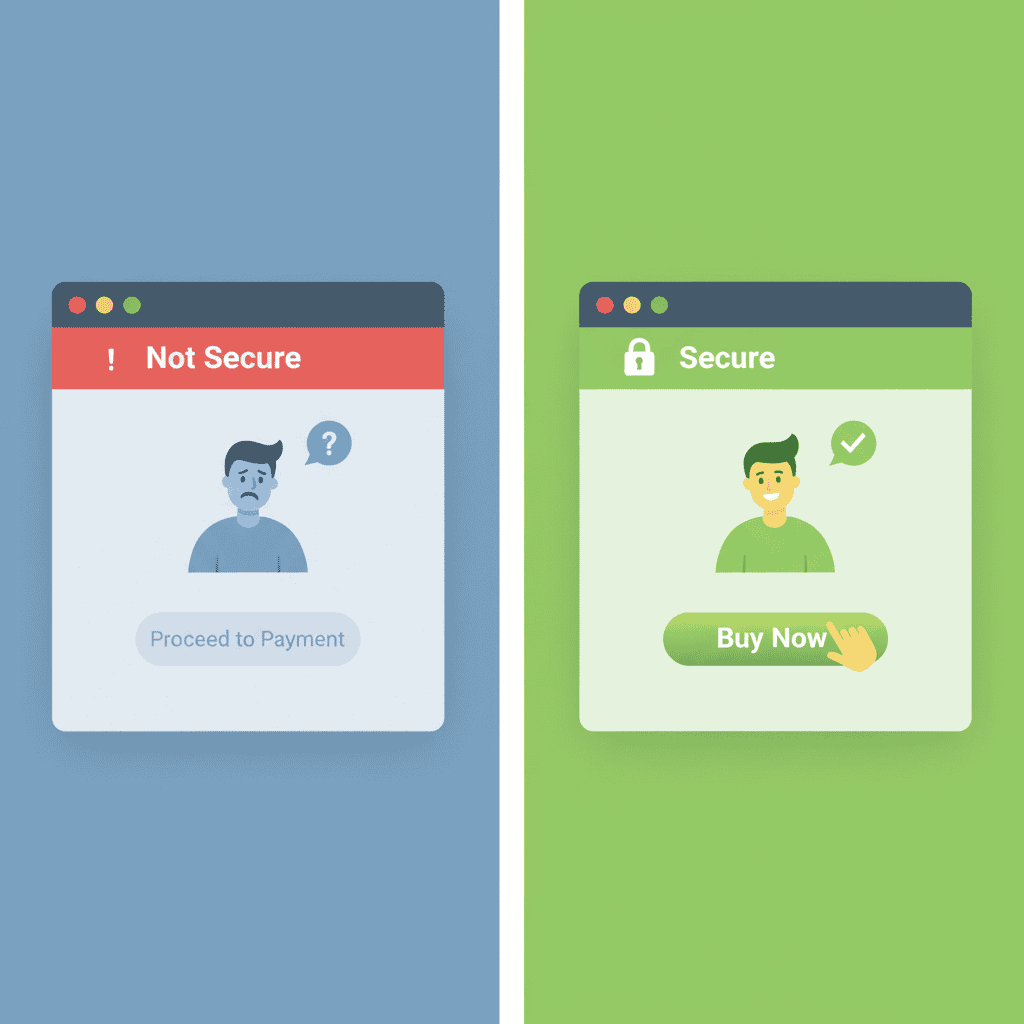
Chrome now actively labels HTTP sites as “Not Secure,” especially if they contain input fields. This visual cue destroys conversion rates. I have seen bounce rates drop by over 15% simply by migrating a client to a proper HTTPS setup. The mechanism here is simple: encryption ensures that the data between the user and the server cannot be intercepted. Google rewards this protection because it aligns with their goal of a safe web.
The Psychology Behind the Padlock Icon
Trust is psychological before it is technical. The padlock icon isn’t just code; it’s a signal that tells the user, “You are safe here.” Cybersecurity impact on search goes beyond algorithms; 57% of organizations view their security posture as a competitive advantage. When users feel safe, they dwell longer, click more, and engage deeper—all of which are behavioral signals that feed back into Google’s RankBrain.
Core Technical Signals That Build Authority
Improving website security signals for trust requires a granular look at your technical infrastructure. It is not enough to just buy a certificate and walk away.
SSL Certificates: Beyond the Basics
Not all SSL certificates are created equal in the eyes of the consumer, even if Google treats the encryption similarly. Depending on your industry, the type of validation you choose can impact user perception.
Here is a breakdown of how different certificates serve different SEO needs:
| Certificate Type | Validation Level | Visual Trust Signal | Best For | SEO Impact |
|---|---|---|---|---|
| Domain Validated (DV) | Low (Automated) | Padlock only | Blogs, Personal Sites | Baseline ranking boost |
| Organization Validated (OV) | Medium (Business check) | Padlock + Org Info | Small Business, Lead Gen | Higher trust for users |
| Extended Validation (EV) | High (Strict vetting) | Padlock + Green Bar (browser dependent) | E-commerce, Fintech, YMYL | Maximum conversion trust |
For most of my clients, an OV certificate strikes the right balance. However, if you are in a YMYL (Your Money or Your Life) niche, the extra vetting of an EV cert can support your E-E-A-T claims.
Fixing Mixed Content and Crawl Errors
One of the most common issues I find during a comprehensive site audit is mixed content. This happens when a secure HTTPS page loads insecure HTTP resources (like images or scripts). The browser flags the page as insecure, negating your SSL investment.
Furthermore, site uptime is a security signal. If your server is frequently down due to DDoS attacks or poor architecture, Googlebot cannot crawl your site. Frequent 5xx errors can lead to deindexing. Ensuring 99.9% uptime is a prerequisite for maintaining the trust signals you work so hard to build.
E-E-A-T and Security: The Invisible Connection
Google’s E-E-A-T (Experience, Expertise, Authoritativeness, Trustworthiness) framework is the lens through which quality is judged. The “T”—Trustworthiness—is directly tied to your security signals.
How Malware Destroys Expertise Signals
Imagine you are a recognized expert in your field. Suddenly, your site is injected with malware due to a plugin vulnerability. Google’s Safe Browsing algorithms will flag your site immediately. Users will see a giant red warning screen.
In that moment, your “Expertise” is irrelevant because your “Trustworthiness” has hit zero.
• 79% of account takeover attacks originate from phishing, which often leads to site compromise.
• Sites flagged for malware can be removed from the index entirely.
• Recovery isn’t instant; it can take 4 to 6 months to regain pre-penalty traffic levels even after the issue is fixed.
This is why I emphasize proactive security as part of my technical SEO framework. You cannot be an authority if your site is a vector for attacks.
YMYL Requirements for Data Safety
If you operate in finance, health, or law, you are in a YMYL category. Google’s Quality Rater Guidelines hold these sites to the highest standard. For YMYL sites, clear contact information, privacy policies, and secure data handling are not optional—they are ranking factors.
Technical trust components like robust privacy pages and visible physical addresses signal to Google that you are a legitimate entity responsible for the advice or services you offer.
Actionable Steps for Hardening Your SEO Defense
So, how do we practically go about improving website security signals for trust? Here is the methodology I use.
Implementing Headers and Standards (OWASP)
We need to look at security headers. These are instructions your server sends to the browser to prevent attacks like Cross-Site Scripting (XSS).
- HSTS (HTTP Strict Transport Security): Forces browsers to load your site in HTTPS only, preventing downgrade attacks.
- Content-Security-Policy (CSP): Restricts where resources can be loaded from, blocking malicious scripts.
- X-Frame-Options: Prevents your site from being framed (Clickjacking).
Implementing these doesn’t just stop hackers; it shows sophisticated site management, a hallmark of high-quality domains.
Displaying Trust Badges Effectively
While Google doesn’t crawl a “Norton Secured” badge and give you 10 points, users do see it. And when users trust a page, they convert. High conversion rates and low bounce rates are indirect signals that tell Google your page satisfies user intent.
However, do not clutter your footer with fake badges. Use verifiable third-party seals (like BBB, McAfee, or industry-specific certifications). Transparency is key. A clear, easy-to-find Privacy Policy and Terms of Service page is essential for passing manual reviews.
Measuring the Impact on Search Visibility
Security improvements are a long game. You won’t see a ranking spike overnight, but you will see a stabilization of your keyword positions.
Recovery Timelines
If you are recovering from a hack or a “Not Secure” penalty, patience is required.
| Action Taken | Typical Impact Timeline | Expected Outcome |
|---|---|---|
| Switching to HTTPS | 2-4 Weeks | Re-indexing of URLs, removal of browser warnings |
| Malware Removal | 1-2 Weeks (for review) | Removal of “This site may be hacked” label |
| Trust Signal Recovery | 4-6 Months | Restoration of organic traffic and domain authority |
Monitoring Tools and Metrics
I recommend using Google Search Console regularly to check the “Security Issues” tab. It is the only direct line of communication from Google regarding your site’s health. Additionally, keep an eye on your list of ranking factors to ensure you aren’t slipping on other technical baselines like speed or mobile-friendliness, which often degrade when security bloat (like heavy plugins) is introduced.
Frequently Asked Questions
What is the most important security signal for SEO?
HTTPS is the foundational signal. Without it, other trust signals (like badges or reviews) are ineffective because the browser will label the entire session as insecure. It is a confirmed tiebreaker in confirmed algorithm signals.
How does a security breach affect my rankings?
A breach can lead to immediate deindexing if Google Safe Browsing flags your site. Even after cleanup, the loss of trust can suppress rankings for months as Google re-evaluates the site’s quality and safety.
Do trust badges really help SEO?
Directly? No. Indirectly? Yes. They improve user trust, which improves engagement metrics (dwell time, bounce rate). These behavioral signals correlate with higher rankings.
Is a free SSL certificate enough for SEO?
For a blog or simple info site, yes. A free certificate (like Let’s Encrypt) provides the encryption Google requires. However, for e-commerce, a paid OV or EV certificate offers better visual assurance to customers, improving conversions.
How often should I audit my site’s security?
I recommend a quarterly deep dive. Security threats evolve rapidly. Regular checks ensure you catch expired certificates or new vulnerabilities before they impact your SEO.
Conclusion
Improving website security signals for trust is about more than avoiding a hack. It is about proving to Google and your users that you are a legitimate, safe, and reliable entity. By implementing HTTPS, hardening your technical defenses, and aligning with E-E-A-T principles, you build a moat around your rankings that competitors cannot easily cross.
Security is the silent partner of SEO. Ignore it, and your visibility suffers. Prioritize it, and you build a foundation for sustainable growth. If you are unsure where your site stands, let’s discuss your security strategy and get your trust signals working for you.
Key Takeaways
• HTTPS is Mandatory: It is a prerequisite for ranking and user trust.
• E-E-A-T Depends on Safety: You cannot demonstrate Trustworthiness on a compromised site.
• Visual Cues Matter: Browser warnings and trust badges directly influence user behavior.
• Recovery is Slow: Prevention is far cheaper than the 4-6 month recovery time from a breach.
• Uptime is Critical: Consistent availability is a key signal of site quality.
Sources & References
• Google Webmaster Central Blog (2014) – HTTPS as a ranking signal.
• Google Quality Rater Guidelines – Definition of E-E-A-T and Trustworthiness.
• Brilliance Security Magazine – Cybersecurity impact on search rankings.
• Safari Digital – Technical SEO ranking factors.