Optimizing Landing Pages for Organic Traffic: 2026 Guide
Key Takeaways
• Speed is Non-Negotiable: Core Web Vitals directly impact rankings; LCP under 2.5s is the target.
• Mobile-First is Mandatory: 60%+ of organic traffic is mobile; design for 44x44px tap targets.
• EEAT Drives Trust: Demonstrating Experience and Expertise is crucial for organic conversion.
• Schema Wins Clicks: Use FAQPage and Product schema to capture rich snippets.
In my years as an SEO consultant, I have seen too many businesses treat landing pages solely as destinations for paid ads. They pour budget into PPC, optimizing for Quality Score, while completely neglecting the sustainable goldmine of optimizing landing pages for organic traffic.
Here is the reality: Paid traffic stops the second you stop paying. Organic traffic, however, builds a compounding asset. But Google’s organic algorithm demands different signals than Google Ads. While ads prioritize relevance and bid, organic search prioritizes user experience, authority, and technical excellence.
If you want to rank your landing pages in 2026, you cannot just stuff keywords into a sales letter. You need a standards-first approach that aligns with Google’s Core Web Vitals and Search Generative Experience (SGE).
The Speed Equation: Core Web Vitals & Organic Retention
When we talk about speed in organic SEO, we are not just talking about convenience; we are talking about access. Google’s Core Web Vitals are the gatekeepers. If your page fails here, it often doesn’t matter how good your copy is—users (and bots) will bounce before they see it.
LCP and the 2.5-Second Threshold
Largest Contentful Paint (LCP) measures how long it takes for the main content to load. According to Google, pages that take longer than 3 seconds to load see a 32% higher bounce rate. For organic traffic, which is often “colder” and more skeptical than paid traffic, this is fatal.
I recommend targeting an LCP of under 2.5 seconds specifically for mobile users. This isn’t just a technical metric; it is a trust signal.
The Cost of Latency
To visualize why this matters, look at the correlation between load times and organic performance metrics:
| Load Time (Seconds) | Probability of Bounce | Conversion Impact | SEO Impact |
|---|---|---|---|
| 1s – 3s | +32% | Minimal Loss | Positive Signal |
| 1s – 5s | +90% | -10% to -15% | Negative Signal |
| 1s – 6s+ | +106% | -20% to -30% | Severe Penalty |
Data synthesized from Google & Akamai benchmarks.
Practical Fixes for Speed
- Compress Images Aggressively: Use WebP formats. Compression to 70-80% quality can cut load times by 30-50% without visible loss.
- Utilize a CDN: A Content Delivery Network reduces latency globally. Cloudflare data suggests this can reduce latency by 50%.
- Lazy Loading: Defer offscreen images so the browser focuses solely on the above-the-fold content initially.
Mobile-First Architecture for Organic Ranking
Google’s Mobile-First Indexing is not new, but the strictness of its application has evolved. If your landing page is desktop-perfect but mobile-clunky, you are invisible to the 60%+ of users driving organic search.
Beyond Responsive Design
Simply shrinking a desktop site is no longer enough. You need to design for the thumb. This means adhering to accessibility standards that Google rewards.
According to WCAG 2.1 standards, interactive elements must have a target size of at least 44×44 CSS pixels. I often see landing pages with tiny text links that frustrate mobile users, leading to “pogo-sticking” (where a user quickly returns to the search results)—a strong negative ranking signal.
For a deeper dive into structural changes, landing page optimization best practices often highlight that removing navigation can boost conversions. However, for organic landing pages, I advise keeping a simplified navigation (like a hamburger menu) or breadcrumbs. Why? Because organic visitors often want to explore the brand before committing, unlike paid traffic that is ready to convert immediately.
Visual Hierarchy and Dwell Time
Organic users are scanners. They are looking for an answer to their query immediately.
• Headline: Must match the H1 tag and the user’s search intent.
• Sub-headline: Value proposition.
• Hero Image: Contextual and fast-loading.
• CTA: Above the fold.
A Moz research report states that optimizing above-the-fold content can reduce bounce rates by 15-20% for informational queries. This dwell time is a critical feedback loop for Google’s ranking algorithms.
Aligning Content with Search Intent & EEAT
Content is where the battle for organic traffic is won or lost. Unlike paid ads where you can force visibility, organic listings require you to earn the spot by proving you are the best answer.
Demonstrating Experience and Expertise
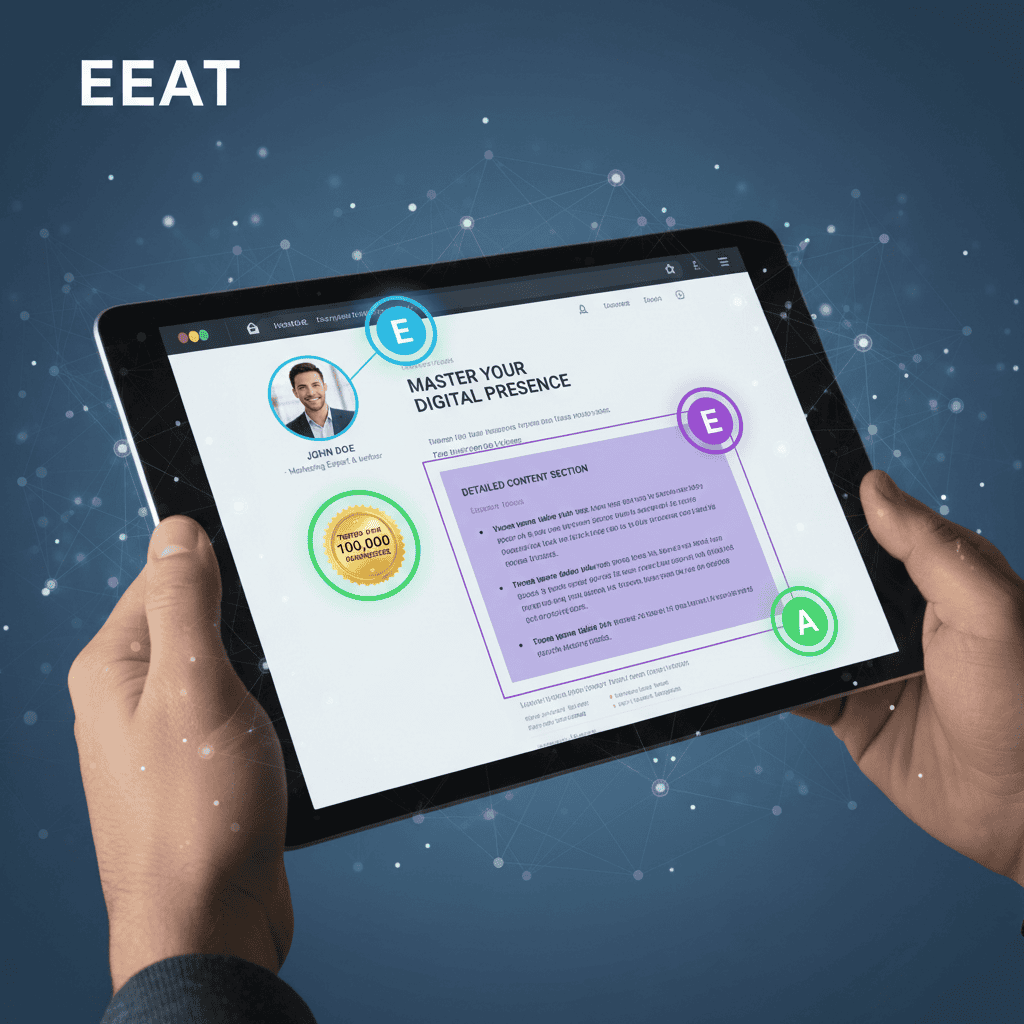
Google’s Helpful Content Update places a massive premium on EEAT (Experience, Expertise, Authoritativeness, Trustworthiness). Your landing page cannot just sell; it must educate.
If you are targeting a keyword like “enterprise SEO software,” your page needs to demonstrate that you understand the nuance of that industry. This is where understanding the difference between local SEO vs national SEO becomes vital. If your landing page targets a local intent (e.g., “SEO services Mumbai”) but uses broad, national terminology, you will fail to rank for the specific geo-targeted queries that drive high-intent organic traffic.
Trust Signals for Cold Traffic
Organic visitors likely do not know your brand yet. You must build trust instantly.
- Social Proof: Testimonials and logos. IAB standards suggest these improve dwell time by 10-15%.
- Author Bios: If the page includes educational content, link to an expert author profile.
- Clear Policies: Links to privacy policies and terms in the footer signal legitimacy to Google’s Quality Raters.
Technical Signals: Schema & Future-Proofing
Technical SEO provides the vocabulary to explain your content to search engines. For landing pages, this is often the missing link.
Structured Data for Rich Snippets
Rich snippets (like stars, FAQs, or prices in search results) can increase Click-Through Rate (CTR) by 20-30%. For landing pages, I always implement:
• Product Schema: If you are selling a specific tool or service.
• FAQPage Schema: This allows you to answer common objections directly in the SERP, occupying more real estate.
• LocalBusiness Schema: Essential for geo-targeted pages.
Implementing these technical elements aligns with broader SEO best practices that prioritize machine readability. Furthermore, as we move toward AI-driven search, these structured data points help Large Language Models (LLMs) understand your offering. This is critical when considering the future of SEO for professional firms, where trust signals and structured data will determine visibility in AI-generated answers.
Measuring Organic Uplift Correctly
One of the biggest pitfalls I see is measuring organic landing pages with paid metrics.
Distinguishing Paid vs. Organic Data
Paid traffic converts faster but retains lower. Organic traffic takes longer to convert but has a higher Lifetime Value (LTV). You must set up Google Analytics 4 (GA4) to attribute conversions correctly.
• Event Tracking: Track “scroll depth” and “time on page” specifically for the organic medium.
• Assisted Conversions: Organic landing pages often serve as the first touchpoint, not the last.
If you are struggling to configure this, many agencies offer specific landing page optimization services that focus on this data granularity. However, doing it yourself starts with understanding your own authority. When you build your personal brand with AI, you create a recognizable entity that users search for directly, which drastically skews your organic data if not segmented properly. Always separate “brand” organic traffic from “non-brand” to see how well your optimization is actually working.
FAQ Section
What are the top SEO factors for landing page rankings?
Top factors include mobile-friendliness (Core Web Vitals), page speed (LCP < 2.5s), relevance to search intent, and authoritative content (EEAT signals).
How does page speed affect organic traffic?
Slow speed increases bounce rates. A load time over 3 seconds can increase bounce rates by 32%, signaling to Google that users are dissatisfied, which lowers rankings.
Should landing pages have navigation for SEO?
Unlike PPC pages where navigation is removed to trap users, organic pages should have minimal navigation (like breadcrumbs or a footer menu) to allow bots to crawl the site and users to verify brand credibility.
How do I use schema for landing pages?
Use FAQPage schema to answer common questions in the SERPs and Product or Service schema to display pricing and ratings, improving CTR.
Conclusion
Optimizing landing pages for organic traffic is a discipline of balance. You must balance the persuasive psychology of a sales page with the technical rigidity of a search engine.
By focusing on the “Three S’s”—Speed (Core Web Vitals), Structure (Schema and Mobile-First), and Substance (EEAT)—you can build pages that not only rank but convert sustainable traffic for years to come. Start by auditing your top 3 landing pages today using PageSpeed Insights and ask yourself: Would I wait for this to load?