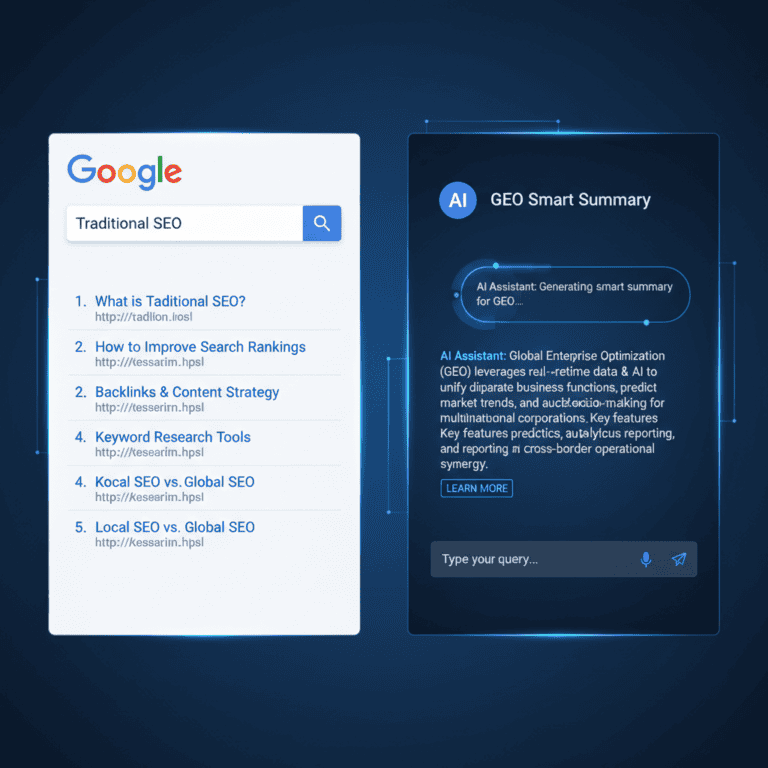
Programmatic SEO Guide: Scale Traffic Without Penalties
Table of Contents
-
What is Programmatic SEO?
-
Programmatic vs. Traditional SEO: The Core Differences
-
The Mechanics: How Dynamic Page Generation Works
-
Strategic Implementation: From Data to Deployment
-
Navigating Risks: Quality, E-E-A-T, and Penalties
-
Frequently Asked Questions
-
Key Takeaways
In the world of search, scale is often the biggest barrier to growth. You might have the best product or the most comprehensive service, but if you are manually writing every single landing page, you are effectively bringing a knife to a gunfight. This is where programmatic SEO changes the equation entirely.
Imagine the difference between manually crafting 50 pages over a month and automatically generating 50,000 high-quality pages in an afternoon. That is not an exaggeration; it is the industrialization of content creation. As an SEO consultant helping businesses in Mumbai and beyond, I have seen firsthand how this strategy can transform a site’s visibility—provided it is executed with precision and care.
Programmatic SEO is not about spamming the index. It is about understanding user intent at scale and serving specific answers to specific queries efficiently. In this guide, we will dismantle the mechanics of this strategy, explore how to implement it safely in 2026, and ensure you stay on the right side of Google’s quality guidelines.
What is Programmatic SEO?
At its core, programmatic SEO is the process of using automation to generate large volumes of search-optimized web pages. Unlike traditional content marketing, where a human writer crafts each sentence for a specific topic, programmatic SEO relies on a combination of structured data and scalable templates.
According to efficiently manage large volumes of webpages, this approach allows brands to creating, optimizing, and managing thousands of pages that target long-tail keywords. It is the secret weapon behind giants like TripAdvisor, Yelp, and Expedia. When you search for “hotels in Mumbai” or “hotels in Delhi,” you are not landing on a page a writer sat down to type out from scratch. You are seeing a dynamically generated page populated with data specific to that location.
The “Head Term + Modifier” Equation
The magic of programmatic SEO lies in targeting long-tail keywords. These are low-volume, low-competition queries that, when aggregated, amount to massive traffic.
The formula is simple:
Head Term (e.g., “Best SEO Agency”) + Modifier (e.g., “in Mumbai”, “in Pune”, “for Small Business”) = Programmatic Opportunity.
By creating a database of modifiers (cities, use cases, integrations), you can deploy thousands of pages that address every possible variation of a user’s search intent.
Programmatic vs. Traditional SEO: The Core Differences
Many business owners I speak with are hesitant to adopt automation because they fear it compromises quality. However, programmatic SEO serves a fundamentally different purpose than traditional “editorial” SEO.
Traditional SEO is about depth and narrative voice—think of a thought leadership article or a complex guide. Programmatic SEO is about utility and scale—think of a stock market ticker page or a weather forecast.
Here is how they compare:
|
Feature |
Traditional SEO |
Programmatic SEO |
|---|---|---|
|
Primary Goal |
Thought leadership, brand voice, complex education |
Utility, answering specific queries at scale, data delivery |
|
Content Creation |
Manual writing, high editorial oversight |
Automated via templates and databases |
|
Target Keywords |
High-volume, high-competition “Head Terms” |
Low-volume, low-competition “Long-Tail Keywords” |
|
Page Volume |
Dozens to hundreds |
Thousands to millions |
|
Update Frequency |
Manual updates required |
Automatic updates via database refresh |
|
Risk Profile |
Low (if quality is high) |
Moderate to High (requires strict technical governance) |
As targeting low-competition keywords suggests, traditional SEO works best for unique, in-depth information, while programmatic is superior for standardized, data-rich content like product listings or location pages.
The Mechanics: How Dynamic Page Generation Works
To understand how we build these systems, you need to visualize the architecture. It is not just “AI writing text”; it is about database management.
1. The Database (The Brain)
This is your source of truth. It could be a Google Sheet, an Airtable base, or a complex SQL database. It holds all the variables you want to insert into your pages. For a travel site, your columns might be: City Name, Average Hotel Price, Best Time to Visit, and Top Attraction.
2. The Template (The Skeleton)
This is the page structure. Instead of hard-coding text, you use placeholders.
-
Static Text: “Discover the best hotels in…”
-
Variable:
{City Name} -
Static Text: “where the average price is…”
-
Variable:
{Average Hotel Price}
3. The Rules (The Logic)
This dictates when pages are created. You might set rules like “Only create a page if {Average Hotel Price} is greater than $0″ to avoid publishing empty or broken pages.
Strategic Implementation: From Data to Deployment
Implementing tailored SEO strategies using programmatic methods requires a disciplined workflow. Here is the exact process I recommend to clients to ensure success without bloat.
Phase 1: Keyword Research at Scale
Do not just look for one keyword. Look for patterns. Use tools to identify modifiers that users frequently append to your core service.
-
Transactional Modifiers: “buy”, “cheap”, “best”, “vs”
-
Geo-Modifiers: City names, zip codes, neighborhoods
-
Industry Modifiers: “for dentists”, “for startups”, “for SaaS”
Phase 2: Data Collection and Cleaning
Your output is only as good as your input. If your database has typos, your 10,000 pages will have typos.
-
Scrape responsibly: Gather data from public sources or APIs.
-
Clean rigorously: Standardize formatting (e.g., ensure all currency formats are identical).
-
Enrich unique data: This is crucial. To avoid “thin content,” add unique data points that competitors lack.
Phase 3: Template Design & User Experience
Google hates “cookie-cutter” sites that offer no value. Your template must be robust.
-
Use Conditional Logic: If a city has no airport, do not show a “Flights to {City}” section. Hide it dynamically.
-
Integrate Media: Programmatically insert maps, charts, or images relevant to the specific page data.
Navigating Risks: Quality, E-E-A-T, and Penalties
This is where most fail. They spin up 100,000 pages of garbage and get deindexed a week later. Northwoods warns that when done poorly, programmatic SEO can dramatically harm your keyword rankings and overall user experience.
To ensure your programmatic strategy contributes to sustainable growth, you must adhere to strict quality standards.
Avoiding the “Doorway Page” Penalty
Google defines doorway pages as sites created just for search engines that funnel users to the same destination. To avoid this:
-
Ensure Unique Value: Each generated page must offer specific value to that query. A page for “SEO in Mumbai” should list Mumbai-specific details, not just generic SEO advice with the word “Mumbai” pasted in.
-
Internal Linking: Don’t just leave these pages as orphans. Link them logically within your site architecture.
-
Human-in-the-Loop: Always manually review a sample set (e.g., 50 pages) before rolling out the full 5,000.
The Role of AI and LLMs
In 2026, we use Large Language Models (LLMs) to generate unique descriptions for each page, preventing the “duplicate content” issue. However, AI can hallucinate. Never let an LLM invent facts (like phone numbers or addresses). Use AI for style and phrasing, but rely on your hard database for facts.
Frequently Asked Questions
1. Will Google penalize me for programmatic SEO?
Not inherently. Google penalizes low-quality content. If your programmatic pages satisfy user intent and provide unique value (E-E-A-T), they will rank. If they are thin, duplicate pages, they will be penalized.
2. How many pages should I publish at once?
Start small. I recommend a “drip feed” approach or publishing in batches (e.g., 100 pages, then analyze, then 1,000). dumping 100,000 pages on a fresh domain can trigger spam filters.
3. Is programmatic SEO expensive?
The initial setup (strategy, database building, template design) has a cost, but the cost-per-page is significantly lower than manual writing. It is an upfront investment for long-term scalability.
4. Can I use programmatic SEO for e-commerce?
Absolutely. It is the standard for e-commerce. Amazon and Etsy are essentially giant programmatic SEO engines, creating pages for every product attribute combination imaginable.
Key Takeaways
-
Scale with Intent: Programmatic SEO allows you to target thousands of long-tail keywords that would be impossible to target manually.
-
Data is King: The quality of your generated pages is directly tied to the quality and depth of your database.
-
Hybrid Approach: The best results come from combining programmatic scale with human oversight and strategic template design.
-
Avoid Shortcuts: Do not use programmatic SEO to spam. Focus on utility and user experience to build a sustainable asset.
Ready to explore how programmatic strategies can work for your specific business model? Feel free to book a consultation and let’s build a roadmap for your growth.