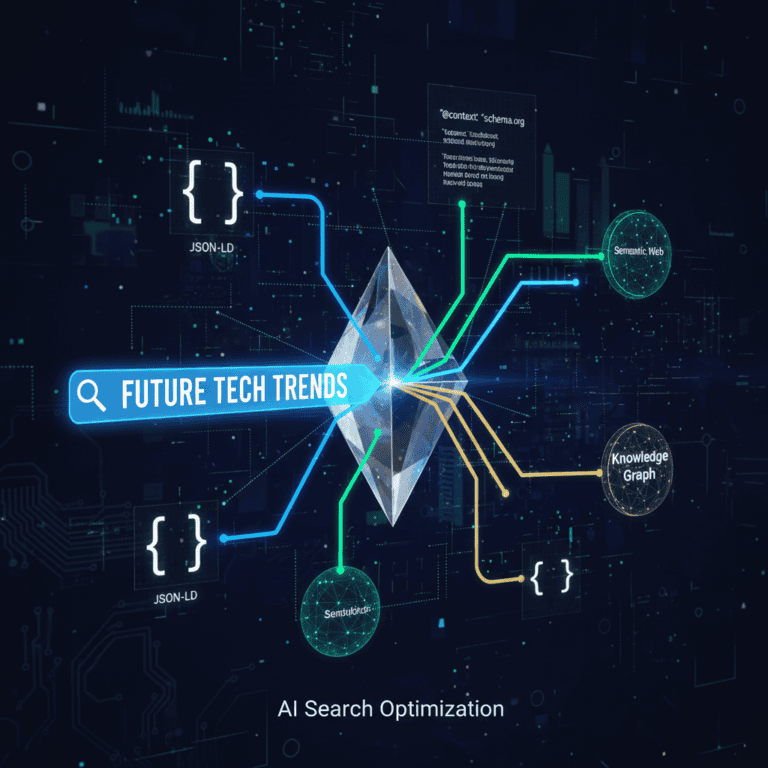
Which Content Signals Help AI Systems Cite a Business?
Which content signals help AI systems cite a business as a source? The short answer is this: content is more likely to be cited when it is easy to extract, easy to verify, clearly tied to a real entity, and supported by evidence beyond the business’s own website. Strong rankings can help visibility, but a page may still be passed over if another source offers clearer proof or a more direct answer.
Table Of Contents
• The Signals Behind AI Citations
• Make Content Easy To Extract And Verify
• Prioritize Content That Can Earn Citations
• Key Takeaways
• Frequently Asked Questions
• Sources
The Signals Behind AI Citations
AI systems do not appear to use one public, fixed checklist for choosing sources. Citation behavior can vary by platform, query type, available sources, and the freshness of the information. Still, the pattern is clear: systems tend to favor pages that offer an answer they can safely connect to a credible, identifiable source.
A useful way to think about citation readiness is through two separate jobs. First, the page must make information extractable. Second, it must make the business believable. A beautifully formatted page with no evidence may be easy to quote but hard to trust. A respected business with vague content may be trusted but difficult to use in a direct answer.
Authority And Independent Corroboration
Content authority is the confidence that a page and publisher understand a topic well enough to be used as evidence. It is not simply a matter of brand size, domain age, or a high volume of content. A small specialist business can demonstrate authority through detailed explanations, documented methods, named sources, and a focused body of work.
External validation strengthens that signal. Adobe identifies content authority and citation consensus as important signals for AI citation. Citation consensus means the same business, fact, product claim, or perspective appears across multiple credible sources rather than only on the company’s own pages.
Consider two accounting firms that publish guides on GST compliance. Firm A says it is “Mumbai’s most trusted advisor.” Firm B explains a specific filing issue, names the relevant form, dates the update, and is independently mentioned in an industry publication. The second firm gives an AI system more material to validate.
I recommend treating third party mentions as corroboration, not as a shortcut. A low quality directory mention may establish basic business information, but an independent editorial mention, professional association profile, event speaker page, review publication, or quoted expert contribution is usually more meaningful because it adds context and distance from the brand’s own claims.
Entity Clarity And Visible Expertise
A business must be unambiguous before it can be reliably cited. Entity clarity means that the organization, its services, products, authors, locations, and subject areas are consistently named and described across the site.
At a practical level, pages should make these details visible:
• The legal or trading business name
• A consistent description of the primary service or product
• Clear contact and location information where relevant
• Named authors, reviewers, or subject matter contributors
• A clear relationship between an author and the topic discussed
• Specific product names, model names, service packages, or methodologies
Visible expertise is not the same as adding an inflated biography. It means showing why a named person or business is qualified to make a particular claim. For a medical clinic, that may include practitioner credentials and review dates. For a software company, it may include product documentation, technical ownership, and version details. For a local service provider, it may include service areas, licensing information, and clearly documented processes.
A 2025 guide from Onely associates visible expertise, answer-first formatting, structured data, original research, freshness, and table-based content with AI citation performance. The important point is not to collect every possible signal. It is to reduce uncertainty about who is speaking, what they are saying, and why the claim can be trusted.
Relevance Beats Generic Authority In Narrow Questions
A broadly authoritative website may not be the best source for a specific question. When someone asks, “What documents are needed to register a private limited company in India?” a concise, current, well-supported guide can be more useful than a general homepage from a large business services platform.
Semrush notes that AI systems can favor sources with stronger credibility, independence, topical authority, and clearer structure. This helps explain why a third party publication may sometimes receive the citation instead of the company that created the product or service being discussed.
The decision often comes down to query fit. A business page should answer the exact question implied by the searcher’s need, rather than surrounding it with promotional copy. A pest control company that publishes “How Long Should You Stay Out Of Your Home After Cockroach Treatment?” may be more citation-ready for that question than a broad “Pest Control Services” page.
Make Content Easy To Extract And Verify
Citation-ready content should not force a system to infer the answer from long paragraphs, marketing slogans, or disconnected visuals. Put the answer in plain language near the top, then provide the reasoning, conditions, sources, and limits beneath it.
A useful test is simple: if a reader copied one paragraph from the page, would it still make sense, identify the subject, and include enough context to avoid misleading someone?
Separate Extractable Signals From Persuasive Signals
This distinction is often missed. Some content signals help a system locate and quote a statement. Others help it decide whether the statement deserves trust.
| Signal Type | What It Helps With | Practical Example | Common Failure Mode |
|---|---|---|---|
| Extractable signal | Finding a direct answer | A one-sentence definition under a descriptive heading | The answer is buried after several promotional paragraphs |
| Extractable signal | Comparing options | A table showing price ranges, features, or eligibility | The table lacks dates, units, or explanation |
| Persuasive signal | Trusting the claim | Named methodology, primary data, or expert review | Credentials are vague or hidden |
| Persuasive signal | Confirming the business | Independent mentions and consistent organization details | Conflicting business names across platforms |
| Dual-purpose signal | Both extraction and trust | A dated statistic with a method note and source label | A number is presented without origin or scope |
Structure can occasionally beat authority when the question is narrow and factual. A lesser known business may be selected because it provides a current, explicit answer in a clean table while a better known competitor uses broad sales language. That does not mean structure replaces reputation. It means the system needs usable evidence before reputation can matter.
Build Proof Into Every Important Claim
A claim becomes more citation-ready when it can be checked. For each high-value statement, readers and machines should be able to identify its scope, date, method, and source.
For example, compare these statements:
• “Our software improves productivity.”
• “In an internal analysis of 120 completed onboarding projects between January and June 2026, customers using the automated checklist completed setup in fewer steps. Results will vary by workflow.”
The second statement is not automatically correct just because it is detailed. But it is far easier to evaluate. It identifies the data owner, timeframe, sample context, measure, and limitation.
Use this proof framework when publishing original findings:
- State what was measured or observed.
- Define the population, date range, and sample size where applicable.
- Explain the method in plain language.
- Separate measured findings from interpretation.
- Include limitations that could change the result.
- Update or retire the claim when the information is no longer current.
Avoid false precision. If a local contractor has completed “more than 200 projects,” do not publish “217 projects” unless that number is maintained and supportable. Unsupported exact figures create a trust problem, not a credibility signal.
Use Structured Pages Without Writing For Machines Alone
Headings, tables, lists, descriptive labels, and structured data help clarify page meaning. They do not guarantee a citation. Their value is that they reduce parsing ambiguity.
Onely’s guidance links answer-first pages, structured data, original research, freshness, tables, and expertise signals with citation-friendly content. I would treat structured data as supporting infrastructure rather than a substitute for good content. It can clarify what a page represents, but it cannot rescue an unsupported claim or an inaccessible article.
A useful page pattern is:
- A direct answer in the opening paragraph.
- A heading that precisely names the question.
- A short explanation of exceptions or conditions.
- Evidence, examples, calculations, or method notes.
- A visible update date when recency affects accuracy.

For instance, a comparison page for two e-commerce platforms should state the comparison criteria before declaring a winner. Specify whether the evaluation concerns transaction fees, inventory tools, Indian payment support, customization, or staff permissions. Without defined criteria, “best” is merely an opinion and difficult to cite safely.
Prioritize Content That Can Earn Citations
Businesses with limited resources do not need a huge publishing calendar. They need a small number of pages that answer costly, recurring customer questions better than generic alternatives. Start with topics where your business has direct knowledge, a defensible point of view, or data that others do not have.
Choose Content Types By Citation Use Case
Different formats serve different questions. The table below is a planning tool, not a guaranteed ranking model.
| Content Type | Best Citation Use Case | Evidence Needed | When To Avoid It |
|---|---|---|---|
| Definition page | Explaining a term or process | Clear scope, examples, current wording | When the topic needs a detailed decision framework |
| Comparison page | Choosing between products, services, or methods | Defined criteria and fair treatment of alternatives | When the comparison is disguised promotion |
| Original data page | Supporting statistics or market claims | Methodology, date, sample, limitations | When the data set is too small or unclear |
| Practical guide | Explaining how to complete a task | Ordered steps, warnings, required tools | When legal, medical, or safety rules require professional advice |
| FAQ page | Answering recurring short questions | Direct, non-duplicative answers | When questions need deeper context than a short answer allows |
| Product documentation | Confirming features or setup requirements | Version details, ownership, update history | When it uses broad marketing language instead of instructions |
Comparison pages can be especially useful because generated answers often need to distinguish options. Yet they fail when they are one-sided. If every competitor is described vaguely while your own product is described in detail, the page may look promotional rather than informative.
A Practical Publishing Order For Small Businesses
I recommend prioritizing by evidence strength and customer importance, not by keyword volume alone. Use this sequence:
- Fix foundational pages first. Make service, product, location, and contact details consistent. Ensure important pages are publicly accessible and readable without requiring a login.
- Publish answer pages for repeated questions. Use questions sales teams, support teams, and prospects genuinely ask. Give the direct answer before the sales message.
- Create one evidence asset. This could be a pricing methodology, industry benchmark, process guide, product specification library, or transparent comparison.
- Strengthen corroboration. Pursue accurate, relevant mentions where the business can add expertise or verifiable information.
- Review freshness on a schedule. Update pages when regulations, prices, product capabilities, standards, or local conditions change.
Fair warning: publishing research simply because “original research gets cited” can backfire. Weak surveys, unclear methodology, or cherry-picked results create content that looks authoritative but is hard to defend. A modest but transparent data set is safer than a dramatic statistic with no method note.
Measure Readiness Before And After Publication
There is no public formula that predicts whether a page will be cited. Instead, use practical proxies to identify weak spots before publishing and monitor outcomes afterward.
| Readiness Check | Question To Ask | Strong Signal |
|---|---|---|
| Answer clarity | Can the main answer be understood in under 60 words? | Direct answer appears near the top |
| Claim proof | Can each major claim be traced to evidence? | Dates, sources, method notes, and limitations are visible |
| Entity clarity | Is it obvious who created the content and what the business does? | Consistent organization and author information |
| Topic depth | Does the page address key conditions and exceptions? | Useful detail without unrelated filler |
| Technical accessibility | Can a crawler reach the primary content? | Important text is available in the page content |
| External corroboration | Do credible independent sources validate relevant facts? | Accurate mentions in contextually relevant places |
Track citation outcomes across a fixed set of important questions over time. Record whether the business is named, linked, accurately described, or recommended beside competitors. If a page is never selected, compare it with the sources that are selected. Look for missing proof, outdated details, vague wording, weak scope, or poor topic fit.
Do not assume that more backlinks alone solve the problem. A page can have strong link equity and still be difficult to cite if its answer is unclear. Likewise, a concise answer page may attract attention but lose credibility if it lacks supporting evidence. The strongest assets combine both sides.
Key Takeaways
• AI citation readiness depends on both extractability and source credibility.
• Direct answers, concise definitions, tables, and clear headings make content easier to use as evidence.
• Dated sources, method notes, limitations, and transparent data improve claim verifiability.
• Clear business, product, service, and author identities reduce ambiguity around who is making a claim.
• Independent mentions can strengthen trust because they corroborate information beyond the business website.
• For smaller businesses, the best first move is often a focused answer page or practical guide built around a recurring, high-intent customer question.
• A page should be current, accessible, and specific enough to answer one question well before trying to cover every related topic.
Frequently Asked Questions
What Content Signals Make AI Systems Cite A Business As A Source?
The most useful signals are direct answers, clear page structure, visible expertise, verifiable claims, current information, entity clarity, topical depth, and independent corroboration. No single signal guarantees selection. A system may choose another source if that source provides clearer evidence or a closer answer to the question.
Which Pages Are Most Likely To Get Cited By AI Answers?
Pages that answer specific questions tend to be strong candidates: definitions, comparisons, practical guides, documentation, research pages, and well-built FAQs. The best format depends on the question. A comparison works for choosing between options, while a process guide works for completing a task.
Do Original Statistics Improve AI Citations?
They can, particularly when the statistic is unique, relevant, dated, and supported by a transparent method. Original numbers without a sample, timeframe, or explanation are less useful. A smaller study with clear limitations is generally more credible than an impressive number with no traceable basis.
Does Structured Data Help AI Cite A Page?
Structured data can help systems understand page entities and content relationships. It should support visible page content, not replace it. Use it when it accurately describes the page, organization, product, article, or FAQ, but do not expect markup alone to create authority.
Are Comparison Pages More Likely To Be Cited Than Blog Posts?
Comparison pages may be useful for decision-focused questions because they organize differences in a reusable format. They are not automatically better than other articles. A fair comparison with defined criteria is stronger than a broad blog post, but a biased comparison can reduce trust.
What Makes A Source Easy For AI To Quote?
A source is easier to quote when it states the answer early, uses specific language, defines important terms, separates facts from opinions, and gives context for numbers or recommendations. Short answer blocks are useful, but the surrounding explanation must confirm that the answer is accurate and current.
How Fresh Does Content Need To Be To Get Cited?
Freshness matters most when facts change often, such as pricing, regulations, product features, schedules, or market data. An evergreen definition may not need frequent rewrites, but it should still be reviewed periodically. Add a meaningful update date only when the content has actually been checked or revised.
What Content Mistakes Stop A Page From Being Cited?
Common problems include vague superlatives, unsupported statistics, anonymous authorship, outdated details, inaccessible main content, unclear business identity, overly promotional comparisons, and answers buried beneath long introductions. The recovery step is usually not more copy. It is clearer claims, better proof, and tighter alignment with the question.
Sources
Adobe Business — AI Search Behavior and Brand Visibility in Customer Journey
https://business.adobe.com/blog/ai-search-behavior-customer-journey-how-to-increase-brand-visibility
Semrush — Why AI Is Citing Third-Party Sources Instead of Your Site?
https://www.semrush.com/blog/ai-citing-my-site-vs-third-party-sources/
Onely — LLM-Friendly Content: 12 Tips to Get Cited in AI Answers
https://www.onely.com/blog/llm-friendly-content/